
Backtest Journal
A complete separate journal for tested trades, with its own dashboard, sessions, strategies and accounts.
6.1What it is for
A strategy needs hundreds of trades before its numbers mean anything, and they must not touch your real record.
6.1.1A journal for what is not real

Backtest Journal is a second journal, for trades you take while testing an idea. You look at an old chart and write down what you would have done, or you trade in the Trade Simulator. The results come here.
A strategy needs many trades before its numbers mean anything. These trades must not touch the record of your real trading. Nothing crosses the line in either direction. Trades, sessions, tags, strategies and accounts of the test side are separate, and the plan counts them separately too.
The row at the top has four tabs, Dashboard, Sessions, Strategies and Accounts. The light behind the words shows where you are. The search in the sidebar and the Calendar belong to real trading and do not show backtests. A reader does not see this tab.
6.2The backtest dashboard
The same screen as the real Dashboard, built only from backtest trades.
6.2.1The dashboard of your tests
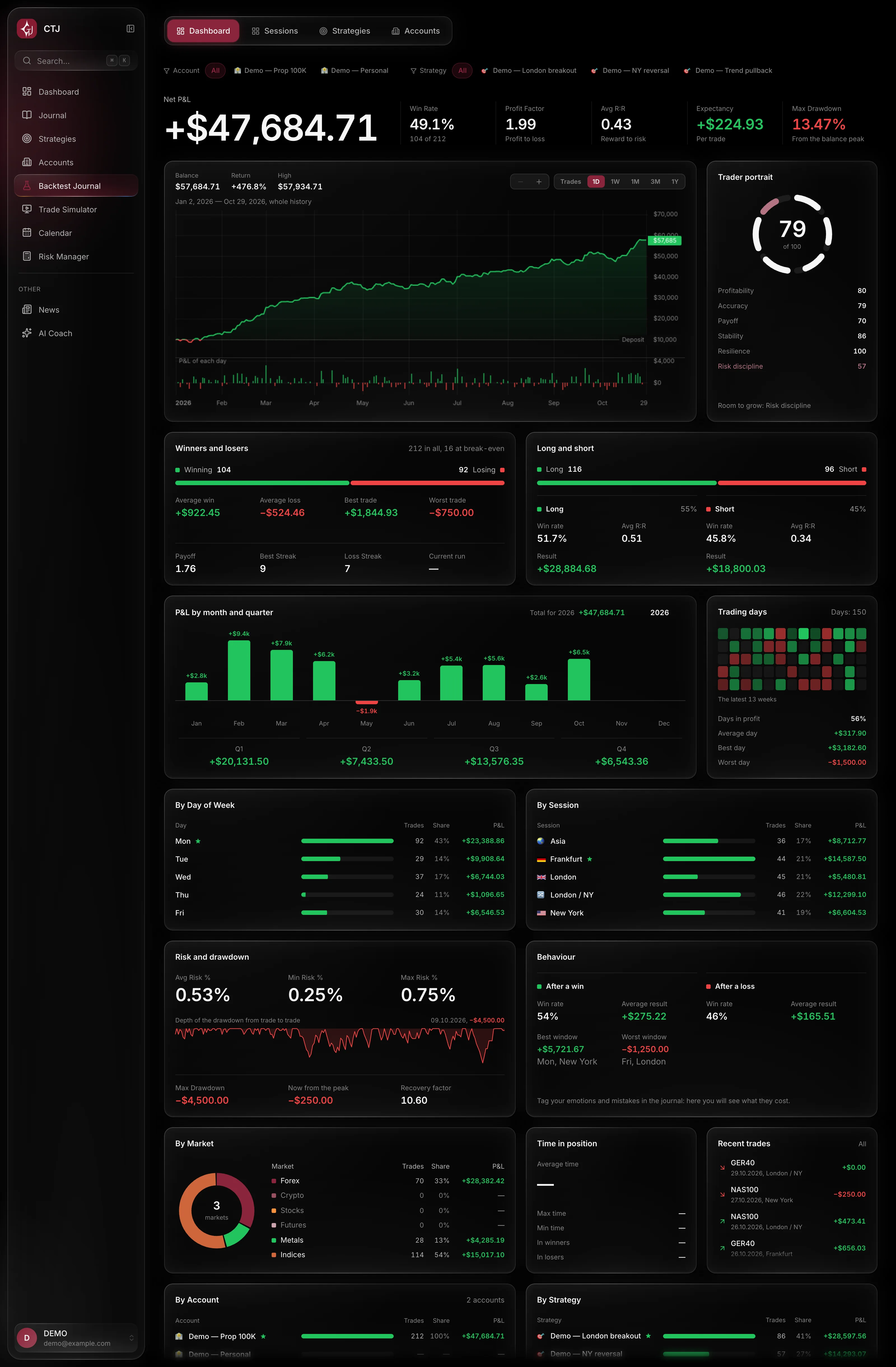
Dashboard here counts backtest trades and nothing else. It shows whether a tested idea earns before you risk money on it. The layout repeats the real Dashboard, and every figure is read in the same way.
Two rows of chips at the top, Account and Strategy, choose what is counted. They list the accounts and strategies of the test side. Press a chip, and the whole page follows. Press All to return. Details → opens a summary of the chosen account or strategy.
6.2.2The figures at the top
Net P&L is the sum of the results in dollars. Five figures stand beside it.
- Win Rate is the share of trades closed in profit.
- Profit Factor divides the money earned on winners by the money lost on losers. Above 1 the test earns.
- Avg R:R is the average reward compared with the risk.
- Expectancy is what one trade brings on average. It is the first number to look at in a test.
- Max Drawdown is the deepest fall from a peak, in per cent.
6.2.3The chart and the portrait
The chart draws the balance of the test over all its trades. The buttons from Trades to 1Y set the size of one bar and hide nothing. and zoom. Hold Ctrl or ⌘ and turn the wheel to zoom around the pointer, and drag to move. Point at a bar to read its date, balance and result.
Trader portrait brings six sides of your trading to one score out of 100. It appears after 10 backtest trades. Room to grow names the weakest side of the test.
6.2.4The cards below
- Winners and losers has the averages, the best and worst trade and the longest runs.
- Long and short compares the two directions.
- P&L by month and quarter draws a year, and the arrows switch years. Dates are the dates of the trades on the chart.
- Trading days is a calendar of the latest 13 weeks. It ends in the week of the latest trade in your current selection.
- By Day of Week and By Session show when the idea works. The star ★ marks the best row.
- Risk and drawdown has the risk per trade and the depth of the drawdown.
- Behaviour shows the next trade after a win and after a loss, the best and worst windows and the price of tagged mistakes.
- By Market divides the trades between markets.
- Time in position compares the time in winners and in losers.
- Recent trades shows the eight most recently added trades. A row opens the tab Sessions.
- By Account and By Strategy compare your test accounts and strategies. A press on a row chooses it for the whole page.
6.2.5Where the curve starts
A backtest has no real deposit, and its curve has a switch of its own. It stands on the Appearance tab of the settings, under Equity chart base — Backtest Journal.
- With deposit starts the curve at 10,000 dollars.
- From zero shows the sum of the results.
The starting balance of your real journal and the settings of single sessions do not change this curve.
6.2.6Hidden and locked sessions
Every session card has an eye . A trade that lives only in hidden sessions leaves this dashboard. A trade that lives only in sessions locked after a plan ended leaves it too. A trade that also belongs to a visible session is counted.
Read also2 Dashboard12.4.4 Equity chart base
6.3Backtest sessions
Sessions, the table and the trade form work as in the journal, with separate limits and an Active mark.
6.3.1Sessions of the backtest
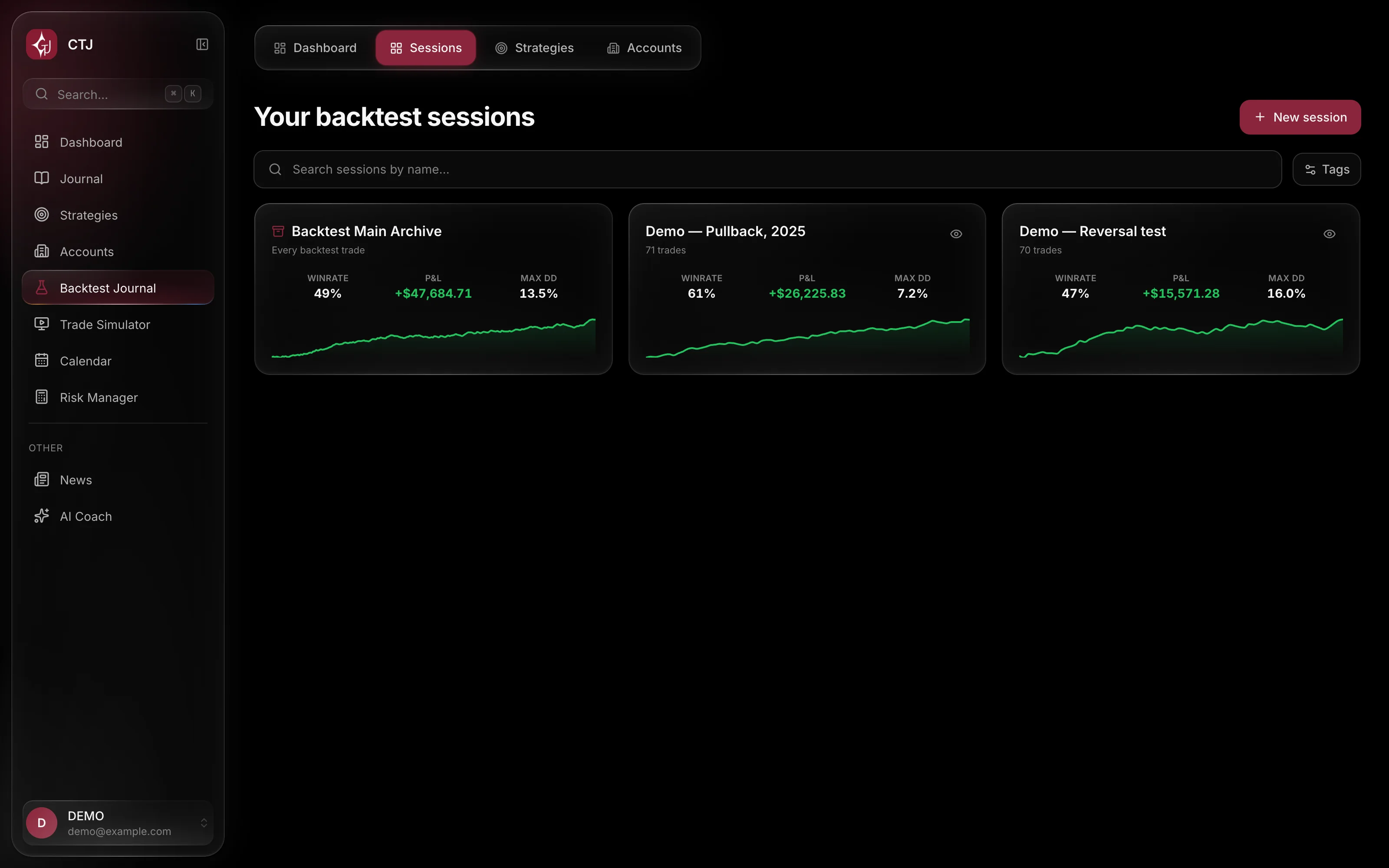
Sessions keeps tests apart from each other. Use one session for one version of an idea, for example London breakout, first version and London breakout, with a news filter. Their cards then compare the versions.
The first card is Backtest Main Archive. Every backtest trade goes here by itself. The archive is for viewing, and it does not count towards your number of sessions.
A card looks the same as in the Journal tab: the name, the number of trades, Winrate, P&L, Max DD and a small equity curve. The mark Active stands on the session that received a trade last. After a break it shows which test you were in. A click opens the session.
6.3.2Creating a session
New session opens a window with six fields.
- Name is required, up to 80 characters.
- Starting balance is the sum the figures of this session count from. Enter a balance if you want to use it in a linked simulator session.
- Instrument is a note about the market, up to 60 characters.
- Strategy and Account are filled in for you in every new trade here. The lists hold the strategies and accounts of the test side.
- Description has room for the conditions of the test, up to 500 characters.
Starter has 2 backtest sessions, Just has 12, PRO MAX has 32 and VIP has 1,000.
6.3.3Finding and hiding
Search sessions by name… looks through names and tags. The row Filter by tags: shows the sessions with any of the chosen tags, and Clear turns the tags off.
The eye on a card hides the session. Its card turns pale and gets the mark Hidden, and its trades are excluded from the dashboard unless they also belong to another visible, unlocked session. brings them back. Nothing is deleted.
6.3.4Tags of the backtest
Tags opens Manage tags. Type a name into New tag…, choose a colour and press Create. changes a tag, and deletes it from every session. Tags are attached in the settings of a session, with Attach tag.
These tags are separate from the tags of the real journal. Starter has 3 with 1 on a session. Just has 12 and 7, PRO MAX has 48 and 12, VIP has 1,000 and 100.
6.3.5Inside a session
The plate at the top says Backtest, and the world you are in is always clear. All sessions returns to the cards. Settings opens the settings of the session.
The trades stand in a table, one row for each trade. The columns go from Date and Symbol through Dir, RR, Risk, Result and P&L to Account, Strategy and Photo. The last two columns hold with the sessions of the trade, for editing and for removing. The table opens with 50 trades, and Show more adds up to 100.
Search symbol or strategy… also matches trade tags. Use the list beside it to filter by market.
6.3.6Filtering a test
opens Trade filters. You can choose days of the week, months, a range of dates, the outcome, strategies and accounts. Unassigned finds trades without a strategy or an account. Buttons in one group widen the choice, and different groups narrow it. Press Apply to use the filter and Reset to clear it.
Order of displayed trades sorts by the date of the trade or by the moment you recorded it. The order of the Backtest Journal is saved apart from the order of the real journal.
6.3.7Recording a backtest trade
Press New Trade inside a session. The symbol, the entry date and the result are required.
- Enter the dates and times of the entry and the exit, as they stand on the old chart. The length of the trade and its market session appear by themselves.
- Type the symbol. The market appears beside it.
- Select ▲ Long or ▼ Short. Choose Take Profit or Stop Loss for the outcome. You can add Break Even to either one to record a small gain or loss near the entry price.
- Enter the amount in P&L ($) without a sign, then enter RR (R:R) and Risk (%). The result sets the sign. Selecting only Break Even sets P&L to zero.
- Choose Account and Strategy. The lists hold the test side only.
- Open Trade psychology and press the tags that fit.
- Write a note. It can hold headings, lists and pictures.
- Add screenshots with Upload file or Paste URL, and choose a timeframe for each.
If you have other backtest sessions, the window Add to other sessions? follows. Tick the sessions and press Save and continue, or press Skip.
Starter holds 55 backtest trades. Paid plans do not count trades. The backtest starts with 2 GB of space on Just, 8 GB on PRO MAX and 80 GB on VIP. When either journal fills its own part, it goes on into the free room of the other.
6.3.8One trade in several sessions, and deleting
One backtest trade can belong to several backtest sessions. in its row opens Where this trade lives. Choose a session and press Attach or Detach.
removes the trade from this session if other sessions hold it too. In its only session, and in the main archive, it deletes the trade for good.
6.3.9Settings of a backtest session
Open Settings inside a session to change its name, tags, instrument, default strategy and account, description or starting balance.
When you create a simulator session, you can use the starting balance of its linked backtest session. If no balance is set, the simulator starts at $100,000. A balance of zero is carried over.
Equity chart base lets you choose between the starting balance and zero. The shared Dashboard chart uses the setting under Appearance. The session card shows the equity curve starting at the selected base, along with P&L, win rate and trade count. Delete session in the Danger zone deletes the session for good, with the trades that lived only in it.
6.3.10Trades coming from the simulator
A position closed in the Trade Simulator can go into a backtest session with the button Add to journal. The trade form opens over the chart with the fields filled in from the position. From Just, you can attach a chart snapshot. Use the same action again to open the saved trade for editing.
Read also3 Journal7.10 Sending a trade to the journal6.4 Backtest strategies
6.4Backtest strategies
The same documents as real strategies, living only in the testing world.
6.4.1Strategies for testing
Strategies holds the rules you are testing. Every card shows Trades, WR and P&L from backtest trades only. opens a strategy, and deletes it without deleting its trades.
Create strategy opens a window over the whole screen with the name, the icon, the accent colour, a long text editor and the tray Images. The editor has headings, lists, checklists, toggle blocks, callouts and pictures you can draw on. ⌘S or Ctrl+S saves.
- The number of strategies is 2 on Starter, 3 on Just, 12 on PRO MAX and 1,000 on VIP.
- The text has up to 1,000 characters on Starter, 7,000 on Just, 28,000 on PRO MAX and 100,000 on VIP.
- The tray holds 1 pictures on Starter, 3 on Just, 24 on PRO MAX and 100 on VIP.
When an idea proves itself, copy its text into a strategy of the real side. Nothing moves there by itself.
Read also4 Strategies7.3 Creating a session
6.5Backtest accounts
A separate list of test accounts, whose notes are full documents.
6.5.1Test accounts
Accounts describes the imaginary conditions of your tests, for example Simulated prop 100k. A card shows the emoji, the colour, the name, the type, Balance, the note and small pictures. Edit opens the account. deletes it, and its trades stay without it.
New Account opens a window with these fields.
- Name is required.
- Type is Demo or Other.
- Starting balance and Currency describe the account, which defaults to 100,000 USD. You can choose USD, EUR, GBP, USDT or BTC. Trade P&L stays in dollars.
- Emoji & color has 26 emojis and 10 colours.
- Use Note (optional) to record the test conditions. The window is the same as in the Accounts tab. The note's limit is 500 characters on Starter, 3,000 on Just, 12,000 on PRO MAX and 50,000 on VIP.
- Images is a tray for 1 pictures on Starter, 3 on Just, 7 on PRO MAX and 10 on VIP. The maximum file size is 1 MB on Starter, 1 MB on Just, 3 MB on PRO MAX and 3 MB on VIP.
Starter has 1 test accounts, Just has 3, PRO MAX has 12 and VIP has 1,000.
An account begins to work when backtest trades carry it. Choose it in the field Account of a trade, or set it as the default of a backtest session.
Read also5 Accounts3.6 Pictures in notes, and drawing on them